A
B
C
D
E
F
G
H
I
J
K
L
M
N
O
P
Q
R
S
T
U
V
W
X
Y
Z
Topic IndexLibrary Index
Click a letter to see a list of conditions beginning with that letter.
Click 'Topic Index' to return to the index for the current topic.
Click 'Library Index' to return to the listing of all topics.
Mastoidectomy and Meatoplasty
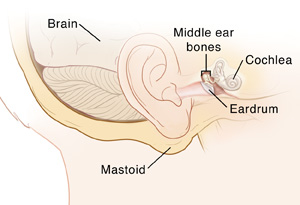
Mastoidectomy and meatoplasty are types of ear surgery. Mastoidectomy removes part of the mastoid bone. This is the bone behind the earlobe. It may be done if tiny air cells in the bone become infected or damaged. These problems can increase the risk of ear infections and hearing loss. Meatoplasty makes the opening into the ear canal (meatus) larger. A meatoplasty may be done with mastoidectomy in a two-part procedure.
How to say it
ma-stoy-DEHK-tuh-mee
mee-AT-oh-pla-stee
Preparing for surgery
Prepare for the procedure as you have been instructed. Tell your doctor ALL the medicines, vitamins, supplements, and herbal supplements you take. This includes any illegal drugs you may use. Some may increase the risk of problems during your surgery. Your doctor will tell you if you should stop taking any of them before the surgery and how soon to do it. Also, follow any directions you’re given for not eating or drinking before surgery.
The day of surgery
The surgery takes about 1 to 3 hours. You’ll likely go home on the same day, or you may stay overnight. Before the surgery begins:
-
An I.V. (intravenous) line is put into a vein in your arm or hand. This line supplies fluids and medicines.
-
To keep you free of pain, you’re given general anesthesia. This medicine allows you to comfortably sleep through the surgery.
During mastoidectomy
Here is what to expect during the surgery:
-
An incision is made behind or near the ear, depending on the type of procedure.
-
The mastoid bone is exposed.
-
The diseased or damaged air cells in the mastoid bone are removed.
-
The bony wall between the ear canal and mastoid bone may also be removed.
During meatoplasty
Incisions are made in and around the ear canal. Then tissue is removed or rearranged to make the ear opening larger.
When both procedures are finished
The ear canal will be filled with antibiotic ointment or fluid. This helps prevent infection. A special kind of dressing (packing) may also be placed in the ear canal. Any incisions made are closed with stitches. A sterile bandage may then be placed over the ear.
After the surgery
You’ll be taken to the PACU (post-anesthesia care unit) to be watched as you wake up from the anesthesia. You’ll be given medicines to manage pain and prevent nausea. If you have packing inside the ear canal, you may have trouble hearing out of that ear. This is not a sign of a problem. Be aware that you may have some dizziness after the surgery. This can last for a few days. When it’s time for you to be released from the hospital, have an adult ready to drive you.
Recovering at home
Once at home, follow any special instructions you are given. Make sure to:
-
Take all medicines as directed. These may include ear drops and ear ointment.
-
Care for your incision and packing as instructed.
-
Make sure you know what daily activities you are allowed to do. Ask about exercise, driving, and travel, especially in an airplane.
When to contact your doctor
Be sure you have a contact number for your doctor. After you get home, contact your doctor right away if:
-
You have chest pain or trouble breathing (call 911).
-
You have a fever of 100.4°F (38°C) or higher, or as directed by your doctor.
-
There is bright red bleeding or foul-smelling drainage from your ear. (Some pink-tinged drainage may be normal.)
-
You have increased redness or swelling around the ear.
-
You have a severe headache and stiff neck.
-
You have facial weakness.
-
You have dizziness, nausea, or vomiting that gets worse.
-
You have pain that can't be controlled with medicines.
Follow-up
During follow-up visits, your doctor will check your healing. If your stitches or packing need to be removed, this may be done in about 7 to 10 days. You and your doctor can also discuss any more treatments or surgeries that may be needed. Going forward, you’ll need regular visits with your doctor to have your ear checked and cleaned.
Risks and possible complications
Risks of these procedures include:
-
Facial weakness or paralysis.
-
Bleeding.
-
Ringing in the ear (tinnitus).
-
Change in sense of taste.
-
Infection.
-
Spinning sensation (vertigo).
-
Leakage of cerebrospinal fluid (liquid around brain and spinal cord) and headache.
-
Hearing loss, which may be permanent.
-
Need for more surgery.
-
Risks of anesthesia.
Online Medical Reviewer:
Melinda Murray Ratini DO
Online Medical Reviewer:
Riley Holtz RN BS
Date Last Reviewed:
8/1/2025
© 2000-2026 The StayWell Company, LLC. All rights reserved. This information is not intended as a substitute for professional medical care. Always follow your healthcare professional's instructions.